I used to visit the Veterans Affairs Medical Center in Providence, RI, a lot as a kid. My grandfather was in and out of the VA throughout a good portion of my childhood. I hated it. There was a cold sterility to the building that made me feel like I just wanted to throw myself out of the nearest window. Picture the Cowardly Lion running down that long hallway in Oz- except I didn’t have the courage. I stayed, made the obligatory trek up to whatever floor my grandfather was on, then waited back in the lobby while my mother finished up whatever she needed to do (calming down my grandmother, filling out endless paperwork).
I was at the VA quite a bit in the summer of 1984. On more than one occasion, I’m sure I walked out of the hospital doors and heard “Born In The U.S.A.” blaring from a car window. The song was ubiquitous that year. You heard it at the beach and in backyards and in the city. Even Ronald Reagan was playing it at his re-election campaign stops (though I’m guessing he either never listened closely to the lyrics or one of his campaign staffers was playing a cruel joke him).
The opening synthesizer riff along with those heavy drums made you pay attention; it required that you pay attention. Before the first word was sung you knew this was something big. But beneath the drums and keyboards and that jingoistic chorus lies a darker American story, a story whose true meaning ironically escaped my pre-teen mind as I walked out of that hospital.
To be born in the U.S.A. means many different things. It means you’re born into the results of an amazing experiment in democracy. It means you’re born into a country where the possibilities are truly endless, where with the right combination of talent, drive, opportunity, and a little bit of luck, you can do anything. But there are costs to being born in the U.S.A. as well. It is not always that shining house on the hill that our forefathers envisioned. One example of this is the way we treat our veterans when they return to civilian life. Our men and women of the military are asked to make the ultimate sacrifice. They are sent into jungles to fight unseen enemies. They are sent into deserts where the line between enemy and civilian is so blurred they don’t know who to trust. And when the blood dries and the dust clears and they make it home, sometimes that’s when the real battle starts.
Came back home to the refinery, hiring man says “Son, if it were up to me”…
Went down to see my V.A. man, he said “Son, don’t you understand”…
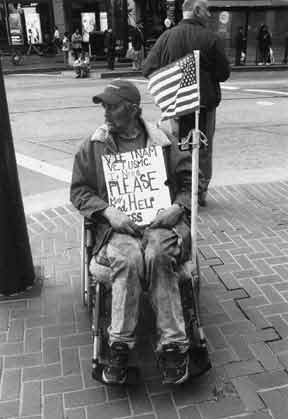
I think of this song every time I pass a homeless veteran holding his “will work for food” sign by the side of the highway exit ramp. It’s hard to assimilate back into normal life after what these soldiers have seen and done. Their veteran’s benefits run out, they can’t find a job, and everything spirals downward. What I believe Springsteen is asking in this song is how did we get to a place where we can’t support the very people who put their lives on the line for us?
I’m ten years burning down the road
Nowhere to run, ain’t got nowhere to go…
It’s now 30 years burning down that road. 30 years since “Born In The U.S.A.” hit the airwaves and 30 years since I’ve been in that VA hospital. I still drive by it a lot. 30 years later I wonder if it still has those non-descript, lifeless white walls. I hope that it’s warmed up a little bit, that it doesn’t feel quite as indistinct. Then I think of the problems at the Walter Reed Medical Center during the Iraq War, I think of the recent problems with VA hospitals across the country, and my hope dwindles.
Independence Day, July 4th, is only a day away. When the last burger has been flipped, and the last firework has gone off, sit back and put “Born In The U.S.A.” on your stereo. But try to find the bluesy, unplugged version that Bruce does. It’s on the Tracks compilation that was released in the late 90’s. Or go find it on You Tube. In this version, the pomp and circumstance of the album version are stripped away, and the lyrics take center stage. And when Monday rolls around, and you’re back to your daily routine, go buy a sandwich and give it to the guy on the corner with the “homeless veteran” sign around his neck. Or give $10 to the Disabled American Veterans organization. Because being “Born In The U.S.A.” is supposed to mean being born into a brotherhood and a sisterhood. And in that brother and sisterhood, we take care of our own.
To donate to the Disabled American Veterans Charity go to http://www.dav.org
“Born In The U.S.A.” is the title track from Bruce Springsteen’s 1984 album of the same name.
 Bruce Unstrung